A kitchen renovation is one of the most exciting investments you can make in your home — and one of the easiest to get wrong. The gap between a kitchen that genuinely transforms how you live and one that looks great in photos but frustrates you every single day usually comes down to a handful of decisions made early in the process. Here’s how to make sure you land on the right side of that line.
Key Takeaways
- Skipping a detailed plan before demolition begins is the single most expensive mistake in any kitchen renovation — decisions made on the fly cost far more than those made on paper.
- Layout and workflow should be locked in before you choose a single finish, fixture, or appliance — function has to lead, not follow.
- Underestimating the true budget is almost universal; experienced renovators build in a 15 to 20 percent contingency from day one to absorb hidden costs without derailing the project.
- Lighting and ventilation are the two most consistently underinvested areas in kitchen renovations, and both are far more expensive to fix after the fact than to plan for upfront.
- Storage planning deserves as much attention as aesthetic planning — most renovation regrets trace back not to the tile choice but to the cabinet layout.
- Choosing materials based on appearance alone, without accounting for durability and maintenance in a real working kitchen, leads to costly replacements within a few years.
- Over-renovating beyond the value of your neighbourhood is a real risk — a great kitchen is an asset, but only up to the ceiling your market can support.
- Working with qualified professionals for plumbing, electrical, and structural work isn’t optional — it protects your investment, your safety, and your ability to sell the home later.
Starting Without a Solid Plan
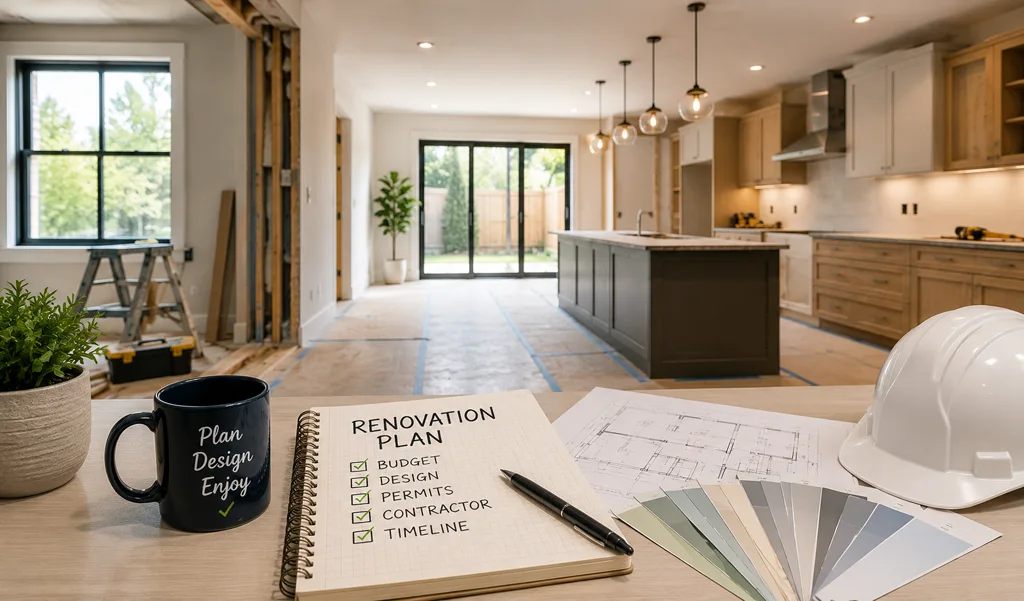
It’s tempting to start tearing things apart the moment the renovation itch takes hold. You have a vision in your head, a mood board on your phone, and a contractor ready to roll. But the most consistent mistake renovation professionals point to — across every budget, every city, every type of kitchen — is beginning construction before a true plan is in place.
A solid kitchen renovation plan isn’t just a rough sketch of where the island might go. It means a defined scope of work, a layout you’ve stress-tested against how you actually cook and move through the space, a complete material list, and a realistic budget that accounts for labour, permits, plumbing, electrical, and the inevitable surprises that appear once walls come down. Skipping or rushing this phase doesn’t save time — it reliably costs more of it, along with money you didn’t budget for and decisions you’ll regret making at eight in the morning with a contractor waiting.
The planning phase is also when you determine the sequence of trades, which matters more than most homeowners expect. If you’re moving plumbing or electrical panels, that work has to happen before cabinets go in. If you’re changing the floor, that affects toe-kick heights and appliance installation. Decisions that feel independent on a mood board are deeply connected in reality, and the plan is where you work all of that out before it becomes expensive to change.
Getting the Layout Wrong
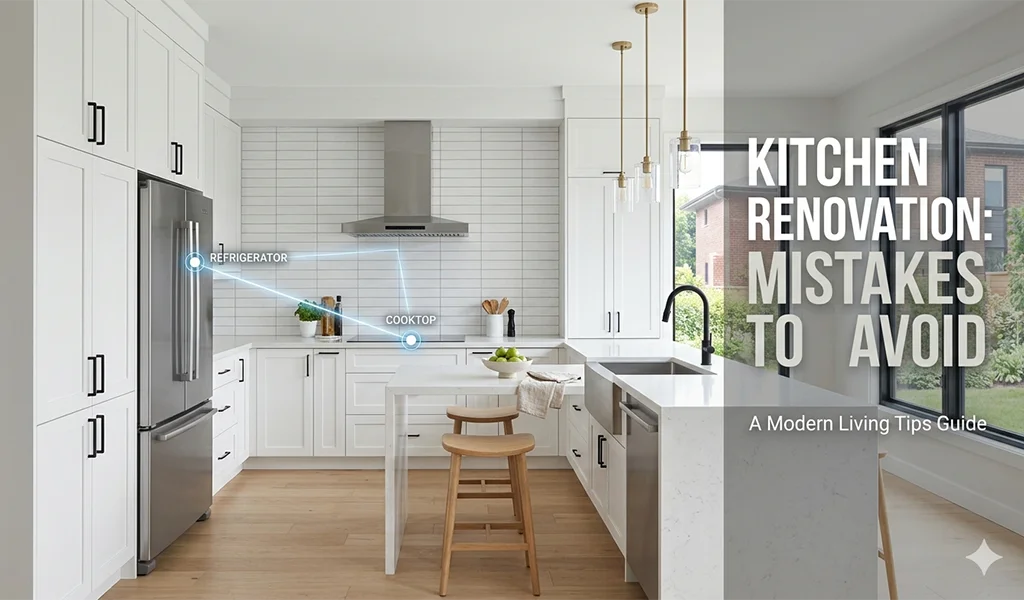
Of all the mistakes you can make in a kitchen renovation, layout errors are the most damaging and the hardest to fix. You can repaint cabinets, replace hardware, swap out light fixtures, and change countertop materials without tearing everything apart. But if your sink, cooktop, and refrigerator are in a relationship that makes no ergonomic sense — or if your island is so large it turns a four-person walkway into a single-file corridor — those problems live with you every day, and correcting them means moving walls and plumbing lines at significant additional cost.
The classic guidance around the kitchen work triangle — the functional relationship between the sink, cooktop, and refrigerator — exists because it reflects how most people actually cook. That doesn’t mean you need to follow it rigidly, but it does mean you need a clear logic behind where your major functional zones land. Prep space deserves particular attention. Homeowners frequently focus on appliances and finishes, then realize mid-renovation that there’s no clear, uninterrupted counter run for actual food preparation. A beautiful kitchen with nowhere to chop vegetables is a design failure regardless of the material choices.
Walkway clearances are another layout detail that gets sacrificed to island ambitions. A minimum of 42 inches of clearance between parallel runs of cabinetry is the functional baseline for a single cook; if two people regularly work in your kitchen at the same time, you want closer to 48. Islands that feel proportionate in a showroom can become obstacles in a real kitchen once the refrigerator is open, a drawer is pulled out, and someone is trying to get to the back door. Measure the space with tape before you commit to dimensions on paper.
Underestimating the Real Budget
Almost every homeowner who has gone through a kitchen renovation will tell you the same thing: it cost more than they thought it would. This isn’t just a matter of contractors padding quotes or prices rising unexpectedly. It’s structural. Kitchen renovations involve multiple overlapping trades — carpentry, plumbing, electrical, tiling, painting, appliance installation — and each one has both visible costs and hidden ones that don’t surface until the work is already underway.
Old wiring that doesn’t meet current code. A subfloor with water damage that only reveals itself once the old flooring is lifted. A ventilation duct that runs exactly where the new upper cabinets need to go. Plumbing that hasn’t been touched in forty years and can’t safely be left as is once you’re opening walls nearby. These aren’t rare surprises — they’re common ones, particularly in homes that are more than a couple of decades old. Building a contingency of 15 to 20 percent into your budget from the start isn’t pessimism; it’s the only honest way to budget for a kitchen renovation.
It’s also worth being clear-eyed about where within your budget you’re making trade-offs. Cabinetry, countertops, and appliances are the three categories that consume the largest share of most kitchen renovation budgets — and they’re also the three areas where quality differences have the most impact on daily use and long-term durability. Economizing on the range hood to afford better cabinetry hardware is a reasonable trade. Economizing on the cabinet boxes themselves to afford a more expensive countertop material usually isn’t — the boxes are the structural foundation of the kitchen, and inferior ones fail within years under the conditions of regular kitchen use.
Ignoring Storage Until It’s Too Late
Storage planning is the part of kitchen renovation that most homeowners underinvest in relative to how much it affects daily life. It’s easier to get excited about countertop materials and cabinet door profiles than to sit down and systematically think through where every pot, pan, appliance, dry good, cleaning product, and cutting board is going to live in the new kitchen. But the homeowners who take the time to do exactly that — to plan storage before a single cabinet is ordered — are the ones who end up with kitchens that stay organized and functional years after the renovation is complete.
Vertical space is the most consistently wasted resource in Canadian kitchens. Upper cabinets that stop several inches below the ceiling create dead zones that collect dust and do nothing. Extending cabinetry to the ceiling eliminates that problem and meaningfully increases storage capacity without changing the kitchen’s footprint. Deep drawers for pots and pans outperform lower cabinets with shelves for most people’s actual usage patterns — pull-out organizers, internal drawer dividers, and corner solutions like pull-out carousels turn otherwise awkward spaces into genuinely useful storage. None of these decisions are expensive relative to the rest of a renovation budget, but all of them require being made before the cabinets are ordered, not after.
Treating Lighting as an Afterthought
Lighting in a kitchen renovation deserves a layered plan — ambient, task, and accent lighting working together — and yet it remains one of the most consistently underthought elements in renovation projects. A single overhead fixture in the centre of the ceiling was never really adequate for a working kitchen, and in 2026, with the design and functional options available, there’s no good reason to settle for it.
Task lighting — specifically under-cabinet LED strips positioned to illuminate the countertop surface rather than casting a shadow from the upper cabinets above — has a practical impact on kitchen usability that is disproportionately large relative to its cost. Pendant lights over an island provide both functional illumination for that zone and a design element that contributes to the character of the space. Recessed lighting in a thoughtful layout creates ambient coverage without the visual weight of a chandelier. Dimmer switches on all circuits give you the flexibility to shift from bright task lighting during cooking to softer ambient lighting during a dinner party without any additional investment.
The reason lighting matters so much from a planning perspective is that retrofitting it after the renovation is complete is genuinely expensive. Running new electrical, patching drywall, and repainting ceilings adds cost that far exceeds what the same lighting plan would have cost to incorporate during the original renovation. Map out your lighting before the electrical rough-in, and you won’t be looking at your finished kitchen wishing you’d thought of it sooner.
Skimping on Ventilation
Ventilation is the unglamorous cousin of every other kitchen renovation decision, and it pays for being ignored in ways that are both immediate and cumulative. A range hood that’s inadequately sized for your cooktop, vented into a ceiling cavity rather than to the outside, or positioned too far above the cooking surface to capture heat and grease efficiently is a ventilation system in name only. The practical result is cooking smells that migrate through the house, grease that slowly accumulates on cabinetry surfaces, and indoor air quality that deteriorates every time you cook at high heat.
The right range hood is sized to the cooking surface it serves — typically expressed as cubic feet per minute of airflow capacity — and it vents directly to the exterior of the home rather than recirculating air through a filter. The hood should be positioned 24 to 30 inches above the cooktop for effective capture without impeding the view or clearance above the range. Noise level, measured in sones, is worth checking as well: a powerful hood that sounds like a small aircraft engine tends to go unused, which defeats the purpose entirely.
If your renovation involves any changes to the cooktop location, that’s the moment to address ventilation comprehensively, including ductwork routing, exterior penetration, and hood selection. Doing it as part of the broader renovation is far more cost-effective than returning to it later as a separate project.
Choosing Materials for Looks Without Thinking About Performance
The visual quality of a kitchen renovation is real and it matters. But materials that photograph beautifully and perform poorly in a real working kitchen are a common source of renovation regret — and they tend to reveal their shortcomings within the first year, when the novelty of the new kitchen has worn off and the practical reality of daily use sets in.
Countertop materials are where this tension shows up most frequently. Marble is genuinely beautiful and also genuinely porous — it stains from acids, scratches more readily than engineered alternatives, and requires sealing and ongoing care that many homeowners find impractical to maintain. Quartz, by contrast, offers consistent performance, resistance to staining, and durability under heavy use without the maintenance demands, which is why it remains the dominant choice in Canadian kitchen renovations. The right choice depends on your specific household and how you actually use the kitchen, not on what looks most impressive in a showroom.
Flooring in kitchens deserves the same lens. Hardwood is warm and beautiful; it also responds to moisture and is more vulnerable to scratching than many homeowners anticipate in a high-traffic cooking environment. Porcelain tile offers near-indestructible durability but requires thoughtful grout colour selection and layout planning to avoid a look that dates quickly. Luxury vinyl plank has improved dramatically in quality and now occupies a genuinely competitive middle ground for many kitchen applications. The question to ask about any material choice is not whether you love it in the showroom but whether you’ll still love it after two years of real kitchen life.
Over-Renovating for the Neighbourhood
There’s a real ceiling on how much a kitchen renovation can add to your home’s resale value, and it’s set not by the quality of your renovation but by the market conditions of the neighbourhood your home sits in. A high-end custom kitchen with integrated appliances, custom millwork, and premium stone surfaces is an extraordinary asset in a home that justifies it. In a neighbourhood where similar homes sell for substantially less, it becomes a renovation that cost more than it can ever return — what real estate professionals call over-capitalization.
This isn’t an argument against renovating well or investing in quality. It’s an argument against making renovation decisions without awareness of what the ceiling of your market actually is. A kitchen that’s well-designed, functional, and finished with quality materials at a reasonable budget point will serve you — and your eventual sale — far better than one that’s spectacular on paper but misaligned with the surrounding market. Know your neighbourhood before you finalize your scope.
DIYing the Work That Needs a Professional
The DIY instinct in kitchen renovations is understandable — labour is genuinely a significant portion of total renovation cost, and there are legitimate ways to reduce that cost through selective self-managed work. Demolition is one. Painting is another. Installing hardware on pre-hung cabinet doors is well within most handy homeowners’ capabilities. But there’s a category of kitchen renovation work where the DIY calculation inverts, and it’s a big one: plumbing, electrical, and structural work.
In Canada, plumbing and electrical work that goes beyond basic fixture replacement almost always requires licensed tradespeople and proper permits. This isn’t bureaucratic friction — it’s the mechanism that ensures the work is done correctly, inspected, and documented in a way that protects both your safety and your home’s insurability and resale value. Unpermitted electrical or plumbing work discovered during a home sale can derail a transaction or require expensive remediation at the worst possible moment. Work done by unlicensed contractors can void homeowner’s insurance coverage for related claims. The cost of doing it right the first time is virtually always lower than the cost of fixing it later.
Not Getting the Right Help From the Start
Every mistake described in this article has a common thread running through it: it’s easier to avoid when you’re working with people who have done this many times before, who ask the right questions early, and who understand how the decisions in a kitchen renovation are connected to each other. The contractor who warns you about the ventilation before demolition begins. The designer who challenges your island dimensions because they’ve seen similar layouts create the same problem in a dozen other kitchens. The kitchen specialist who makes sure your appliance selections are finalized before cabinets are ordered, not after.
If you’re planning a kitchen renovation and want to work with a team that brings both design expertise and construction quality to the process, Andre Kitchen & Bath specializes in full kitchen and bathroom renovations — the kind where layout, storage, lighting, and material choices are all worked through before a single cabinet is ordered. Getting that kind of expertise in the room early is the most reliable way to avoid the mistakes that cost the most to fix.
A kitchen renovation done thoughtfully is one of the best investments you can make in your home and your daily quality of life. The difference between getting it right and getting it almost right often comes down not to budget or ambition, but to the quality of the planning and the people involved in executing it. Start there, and most of the rest tends to fall into place.