
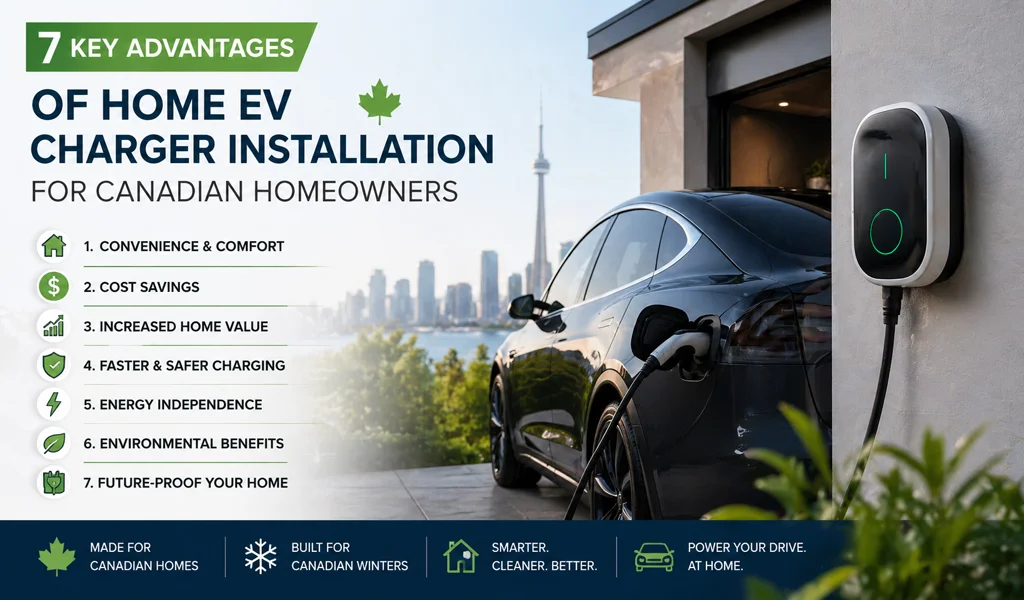
Key Takeaways
- Home EV chargers cut charging costs significantly compared to public stations, with most owners saving hundreds of dollars per year on fueling.
- A Level 2 home charger fully recharges most electric vehicles overnight, eliminating range anxiety and detours to public chargers.
- Professional installation increases property value, qualifies homeowners for federal and provincial rebates, and ensures long-term electrical safety.
- Home charging is more environmentally friendly, especially in Ontario where the grid is largely powered by clean energy sources.
Switching to an electric vehicle is one of the smartest lifestyle upgrades a Canadian homeowner can make, but the real game-changer happens once you stop relying on public stations. A dedicated home EV charger transforms how you drive, how you budget, and how you think about energy at home.
If you’re considering adding one to your property, here’s a clear look at the biggest advantages, plus what to expect from the installation process.
1. Significantly Lower Charging Costs
Charging at home is dramatically cheaper than using public DC fast chargers. Residential electricity rates in Ontario, especially during off-peak hours, can be a fraction of what commercial charging networks charge per kWh.
Over the course of a year, the savings add up quickly:
- Off-peak charging: Schedule your charger to run overnight when electricity rates are lowest.
- No subscription fees: Avoid monthly memberships from third-party charging networks.
- Predictable budgeting: Your charging cost simply blends into your home electricity bill.
2. Faster, More Convenient Charging
Standard wall outlets (Level 1) only add about 5–8 km of range per hour, which is barely enough for daily commuters. A Level 2 home charger delivers 30–50 km of range per hour, fully recharging most EVs overnight.
That convenience changes daily life. You wake up to a “full tank” every morning, skip detours to public stations, and never worry about waiting in line behind another driver during a road trip prep day.
3. Increased Property Value
EV adoption in Canada is rising fast, and homebuyers are paying attention. A professionally installed Level 2 charger is becoming a sought-after feature, much like a finished basement or upgraded kitchen.
Real estate listings increasingly highlight EV-ready garages as a selling point, particularly in suburban markets across the GTA. If you’re already planning upgrades, an EV charger pairs well with other forward-looking improvements covered in the top home renovation trends Canadian homeowners are loving in 2026.
4. Access to Rebates and Incentives
Both federal and provincial programs help offset installation costs, making the upgrade more affordable than many homeowners realize. Eligibility and amounts change periodically, so it’s worth checking current programs before you commit.
Common incentive categories include:
- Federal EV charger rebates through Natural Resources Canada’s ZEVIP program.
- Utility-specific incentives from local providers for off-peak charging setups.
- Manufacturer rebates bundled with select EV purchases or charger brands.
5. Improved Electrical Safety
Plugging an EV into a regular outlet for hours on end is a fire risk most homeowners underestimate. Older household circuits weren’t designed for the sustained, high-amperage draw an EV requires, which can lead to overheated wiring and tripped breakers.
A licensed electrician will assess your panel capacity, install a dedicated circuit, and ensure the charger meets Ontario Electrical Safety Code requirements. For homeowners in the GTA, professional home EV charging station installation in Markham handles the panel upgrades, permits, and inspection coordination so the system is safe and code-compliant from day one.
6. Smart Features and Energy Management
Modern Level 2 chargers come with app-based controls that go far beyond simple on/off functionality. Many homeowners are surprised by how much insight and automation a smart charger adds to their routine.
Popular smart features include:
- Scheduling charges around time-of-use electricity rates.
- Tracking energy usage and cost per session.
- Setting charge limits to preserve battery health.
- Integrating with home solar panels or battery storage.
7. Lower Environmental Impact
Ontario’s electricity grid is one of the cleanest in North America, drawing heavily from nuclear and hydroelectric sources. Charging your EV at home in Ontario typically results in far lower lifetime emissions than gasoline vehicles, and even cleaner results than EVs charged in coal-heavy regions.
Pairing your charger with energy-efficient home upgrades amplifies the benefit. If you’re already rethinking your space, browse our home improvement guides for ideas that complement an EV-ready lifestyle.
What to Consider Before Installation
Before booking an electrician, take stock of your home’s current electrical capacity and your long-term EV plans. A 100-amp panel may need an upgrade if you’re already running heavy loads from appliances, HVAC, or a planned renovation.
Key planning questions to answer:
- Panel capacity: Do you have spare amperage for a 40A or 50A circuit?
- Charger location: Garage, driveway, or carport? Distance from the panel affects wiring costs.
- Future-proofing: Will you eventually own two EVs or add solar?
- Permit requirements: Your municipality and ESA inspection should both be factored in.
Just as planning matters when avoiding the most common kitchen renovation mistakes, getting the prep right before EV charger installation prevents costly do-overs later.
Final Thoughts
A home EV charger is more than a convenience upgrade. It’s a long-term investment that pays back in lower energy costs, greater daily flexibility, higher property value, and a smaller carbon footprint. With rebates still available and EV adoption climbing across Canada, there’s rarely been a better time to make the switch.
Work with a licensed electrician, plan for your future energy needs, and you’ll have a charging setup that serves your household reliably for years to come.